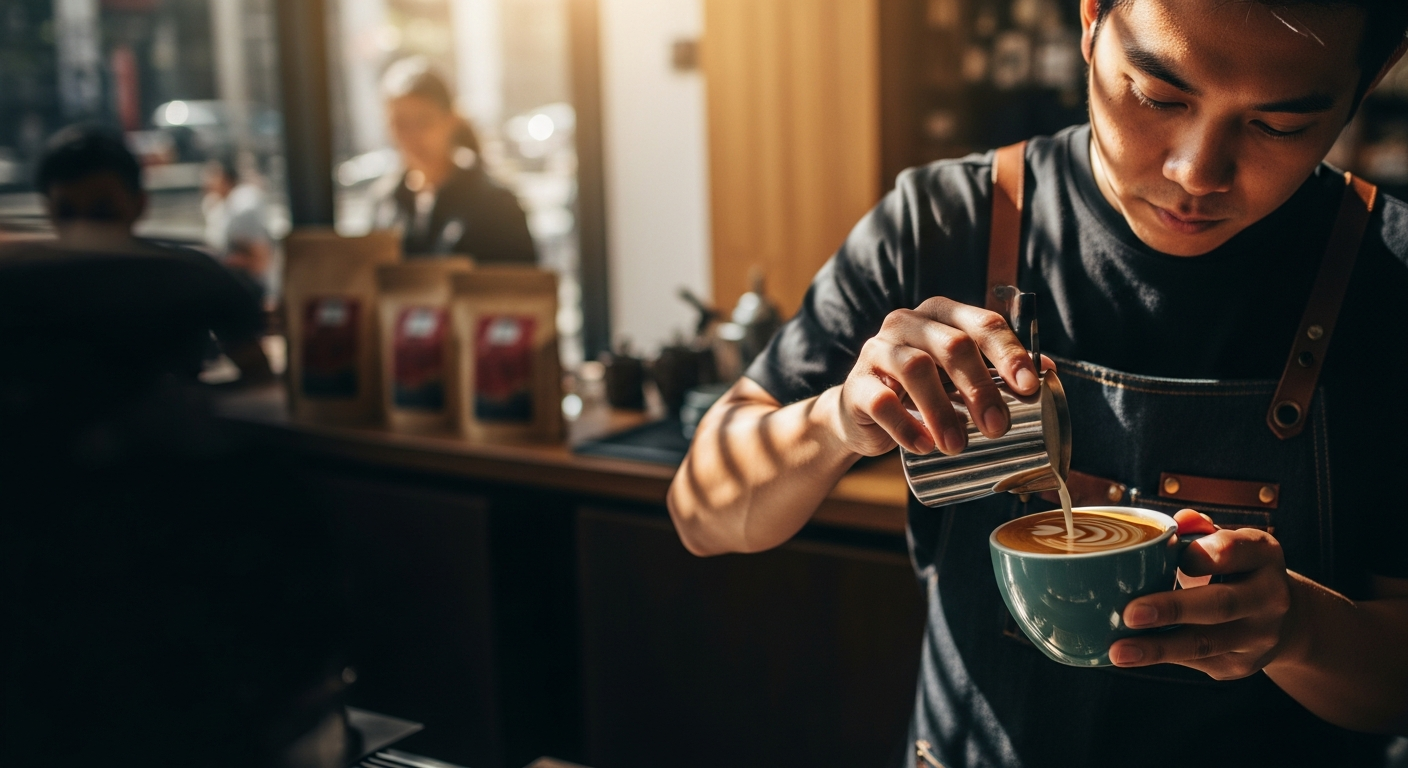
I still remember the exact moment I understood what was happening. I was sitting in a tiny café on a backstreet in Kyoto—the kind of place you’d walk past a hundred times and never notice—holding a ceramic cup of single-origin Ethiopian washed through a Kalita Wave, watching the owner adjust the angle of the kettle like a surgeon. No music. No small talk. Just the quiet ritual of someone who genuinely believed that the two minutes it took to brew that coffee mattered. That moment changed how I travel, and honestly, how I live.
I’ve since chased that feeling across fourteen countries and more cups of coffee than I care to count. And what I’ve come to understand is that what’s happening in Asia right now isn’t just a coffee trend—it’s a full-blown renaissance. A beautiful, complex, still-unfolding movement that’s reshaping how the world thinks about specialty coffee from the ground up.
Coffee in Asia isn’t just something people drink anymore—it’s something people explore.
What Asia’s Coffee Renaissance Actually Feels Like
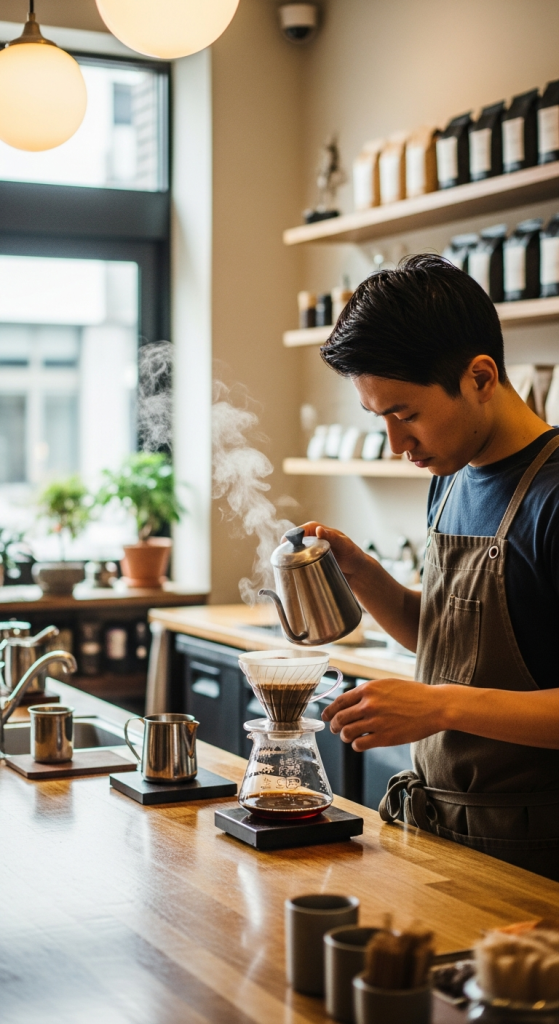
Walk through Tokyo’s Shimokitazawa neighborhood at 9am on a Saturday and you’ll feel it immediately. The cafés are hushed, intentional spaces. Roasters work behind glass. Menus read like tasting notes from a sommelier. People sit alone at counters with their noses gently dipped toward their cups, not scrolling, just… tasting.
The same is true in Seoul’s Seongsu district, in Bangkok’s riverside café corridors, in Taipei’s alleyway espresso bars. The specialty coffee culture sweeping across Asia isn’t just about good beans—it’s about a relationship with coffee that’s deeply thoughtful. Roasters are sourcing micro-lots, baristas train for years to master a single brew method, and cafés are designed with the same precision as art galleries.
What strikes me most as someone who has wandered through coffee cultures on every continent is how genuinely curious Asian coffee culture is. There’s no pretension here, no gatekeeping. Just an infectious sense that coffee is worth understanding, worth slowing down for.
The Farms Fueling the Movement
Here’s what a lot of people miss when they talk about Asia’s coffee renaissance: the story isn’t just happening in the cafés. It’s happening on farms, in processing stations, in the misty highlands that most travelers never see.
I spent three days last year on a small farm in northern Thailand’s Doi Chaang region, and I left with a completely different understanding of what “specialty coffee” actually means. The family there—third generation farmers who had switched from opium cultivation to coffee decades ago—were experimenting with anaerobic natural processing, hand-sorting cherries three times, and fermenting in sealed tanks at controlled temperatures. The cup they produced tasted like a blueberry compote over dark chocolate. I’ve paid a lot of money for wine that tasted less interesting.
Across the region, similar transformations are underway. Vietnam, for so long dismissed by specialty buyers as a commodity robusta producer, is quietly developing arabica farms in the highlands around Da Lat that are genuinely worth hunting down. Indonesia’s Sumatra continues to produce those deep, earthy, full-bodied profiles that serious roasters love, but now processors in Flores and Sulawesi are adding nuance through honey and washed methods that were unheard of a decade ago. China’s Yunnan province is producing specialty-grade coffees that are winning awards at international competitions. India’s Karnataka and Kerala estates are doing work with traditional varieties like S795 and Kent that is quietly blowing the minds of European importers.
The cup from that Thai hillside farm tasted like blueberry compote over dark chocolate. I’ve paid a lot of money for wine that tasted less interesting.
What unites all of these regions is investment—in knowledge, in altitude, in processing equipment, and in the patience required to step back from commodity pricing and reach for something better. The farmers making these choices are often taking real financial risks to do so. I’ve sat with enough of them to know how much courage that takes.
The Cafés That Made Me Rearrange My Itinerary
I have, on more than one occasion, booked a flight extension because of a café. I’m not embarrassed about this.
There’s a shop in Seoul—a place I won’t name because the last time I mentioned it online the line tripled—where the owner does a daily cupping at noon and will invite anyone who shows up to pull up a chair. No charge, no obligation. Just an hour of tasting and talking about coffee. The first time I went, I sat next to a retired textile worker, a Korean American software engineer visiting family, and a Norwegian barista on vacation. We didn’t share a common language. We shared about six coffees and somehow had one of the better conversations of that trip.
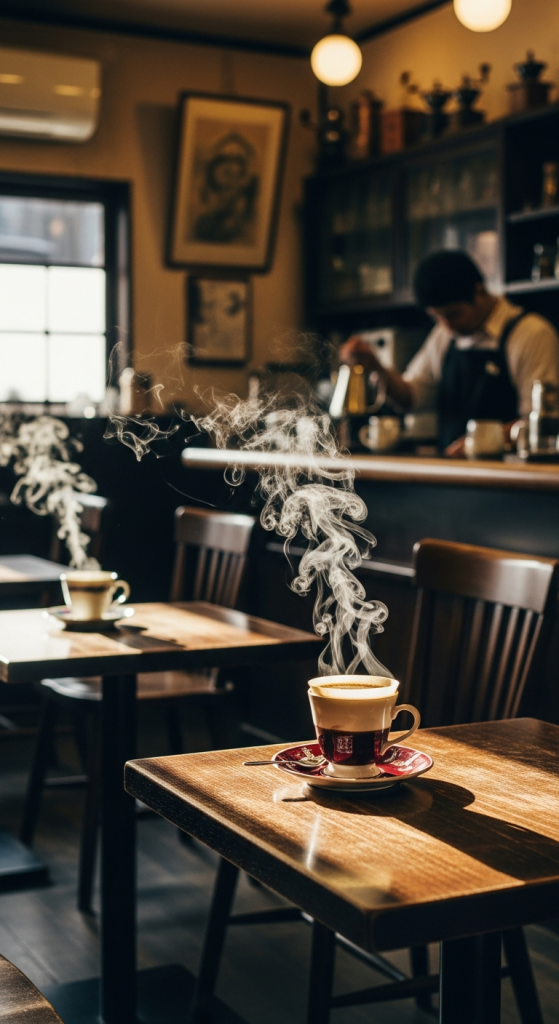
Tokyo has the density of great cafés that New York has for pizza—you’re basically never more than a ten-minute walk from something excellent. What I love about Tokyo’s coffee culture specifically is how it handles tradition. There are kissaten—old-style Japanese coffee houses—that have been brewing drip coffee the same way since the 1970s, and they sit comfortably alongside third-wave roasters using the latest gear. The city somehow makes room for all of it.
Bangkok surprised me more than anywhere. The café scene there moves at a pace that feels slightly electric—new concepts opening monthly, chefs collaborating with roasters on coffee-and-food pairings, old shop houses getting converted into multi-roaster tasting rooms. Taipei has a quieter energy but a depth I keep returning to: the Taiwanese café industry trains its baristas rigorously, and the level of consistency you find in even mid-tier shops is remarkable. Shanghai I have complicated feelings about—the commercialization has arrived faster than anywhere—but the serious operators are holding their own, and the sheer number of educated coffee consumers now in that city is genuinely moving the global market.
How Asia Is Changing the Global Coffee Conversation
I was in Melbourne a few years back when I had an interesting conversation with a roaster who had just returned from sourcing trips in Yunnan and Laos. He told me, unprompted, that his understanding of what specialty coffee could taste like had been fundamentally expanded by what Asian producers were doing with fermentation and processing. “I came back with flavors I couldn’t have imagined before,” he said. “I had to rethink my entire roast profile approach.”
That’s the thing about Asia’s coffee renaissance: it isn’t happening in isolation. Asian baristas are regularly winning or placing at the World Barista Championships. Asian roasters are developing distinct flavor philosophies—many Japanese roasters favor medium-to-light roasts that preserve delicate aromatic compounds in ways that feel distinct from Scandinavian light-roast approaches. Asian cafés are influencing interior design, service philosophy, and menu structure for shops opening in London, New York, and Sydney.
And the cross-pollination flows both ways. The best cafés in Tokyo and Seoul carry beans from Ethiopia, Colombia, and Guatemala alongside their Asian micro-lots. The best farms in Thailand and Vietnam are learning processing techniques developed in Costa Rica and Kenya. It’s a genuinely global conversation now, and Asia has moved from the margins to the center of it.
What’s Coming Next
I’ll be honest: I don’t love making predictions. Coffee has surprised me too many times. But there are a few things I’m watching closely.
Coffee tourism is beginning to take off in a meaningful way. I’m seeing more travelers—not just coffee obsessives, but curious food-and-culture travelers—building itineraries around farm visits in northern Thailand, cupping sessions in Yunnan, and roastery tours in Seoul. This is genuinely good for producers. Direct relationships and consumer awareness of origin translate into better prices at the farm level.
Sustainability is increasingly non-negotiable among the serious producers. Climate change is a real and immediate threat to coffee farming at altitude—I’ve heard this from farmers across the region with a directness that stays with you. The operations investing in shade-grown cultivation, soil health, and water management aren’t just being ethical; they’re being practical. The farms that will still be producing great coffee in thirty years are already building those systems now.
And technology is quietly doing interesting things. Climate monitoring on farms, data-driven roasting systems, better traceability tools—these aren’t replacing the craft, but they’re giving producers more information to work with. The best operators I’ve met use data the way a winemaker uses it: as one input among many, never as a substitute for attention and sensory judgment.
The farms that will still be producing great coffee in thirty years are already building those systems now.
At a Glance
| Category | Key Insight |
|---|---|
| What it is | The rapid rise of specialty coffee culture, café innovation, and quality farm production across Asia |
| Leading producing regions | Vietnam, Indonesia, Thailand, China’s Yunnan, India |
| Leading coffee cities | Tokyo, Seoul, Bangkok, Taipei, Shanghai |
| What’s driving it | Café design philosophy, advanced processing methods, barista craft, and curious consumers |
| Global impact | New flavor profiles, barista champions, fresh sourcing partnerships, evolving roast styles |
| What to watch | Coffee tourism, sustainability investment, direct trade, and climate-adaptive farming |
Questions I Get Asked a Lot
What exactly is Asia’s Coffee Renaissance?
It’s the wide-ranging shift happening across Asia right now—new specialty farms producing world-class coffee, innovative cafés redefining the customer experience, and a generation of producers and consumers who treat coffee as something worth genuine attention. It’s not one country or one trend. It’s a movement.
Why does it matter for specialty coffee globally?
Because it’s expanding the boundaries of what specialty coffee can taste like, where it can come from, and what a great café can feel like. Asian producers are bringing entirely new flavor profiles to the global market. Asian cafés are influencing how coffee is presented worldwide. That diversity makes the whole industry richer.
Which countries should I pay the most attention to?
Japan and South Korea for café culture and barista craft. Vietnam, Thailand, Indonesia, China, and India for the producing side. But honestly, the real answer is: all of them. The landscape is moving faster than any summary can keep up with. The best thing you can do is go.
What does this mean for coffee farmers in Asia?
It creates real opportunity. Specialty markets pay more than commodity markets—sometimes dramatically more. Farmers who invest in quality processing, better varieties, and traceability can access buyers who value what they’re doing. It’s not a guaranteed path, but it’s a genuine one. And increasingly, it’s the path that the most ambitious producers across the region are choosing.
I have a rule when I travel: always find the coffee first. It tells you something about a place—its pace, its values, the kind of attention it pays to small things. By that measure, Asia right now is telling a very good story. I plan to keep listening.
Coffee is never just coffee. In Asia right now, it’s a whole conversation — and honestly, it’s one of my favorites. Stay curious, stay caffeinated. — Ms. Bean
Leave a Reply